
By the Neurology and Emergency Care Team, Alright Hospital, Nagpur Published: June 2026 | Medically Reviewed: Alright Hospital Neurology Department Sources: 2026 AHA/ASA Acute Ischemic Stroke Guidelines, Journal of Neurosciences in Rural Practice 2025, Annals of Neurology 2024
A stroke is a brain emergency where every minute of delay causes irreversible brain cell death. Recognise the FAST warning signs, Face drooping, Arm weakness, Speech difficulty, Time to call for help, and get to the nearest stroke-capable hospital in Nagpur immediately. At Alright Hospital, emergency stroke care is available at the Jafar Nagar branch with CT imaging and neurology support.
What Is a Stroke and Why Does Every Minute Count?
A stroke occurs when blood supply to part of the brain is suddenly cut off. Brain cells begin dying within minutes of losing oxygen and glucose. The most widely cited figure in stroke medicine, supported by decades of clinical evidence, is that approximately 1.9 million brain neurons are lost every single minute that a large artery occlusion goes untreated.
Published in the Journal of Neurosciences in Rural Practice by researchers from the All India Institute of Medical Sciences Guwahati in June 2025, a comprehensive review confirmed that the golden hour, the first 60 minutes after stroke symptom onset, is the critical window during which rapid diagnosis and treatment deliver the best possible outcomes. <cite index=”13-1″>Timely thrombolysis with intravenous tissue plasminogen activator or endovascular thrombectomy can significantly reduce infarct size and improve functional recovery.</cite> [1]
This is not a figure of speech. It is the biological reality of what a stroke does to the brain in real time, and it is why the difference between calling for help immediately and waiting to see if symptoms improve can be the difference between full recovery and permanent disability.
There are two main types of stroke. An ischaemic stroke, which accounts for roughly 87 percent of all strokes, occurs when a blood clot blocks an artery supplying the brain. A haemorrhagic stroke occurs when a blood vessel in the brain ruptures and bleeds. Both are emergencies. Treatment differs depending on type, which is why imaging at a hospital is the essential first step before any treatment can begin.
The FAST Warning Signs of Stroke
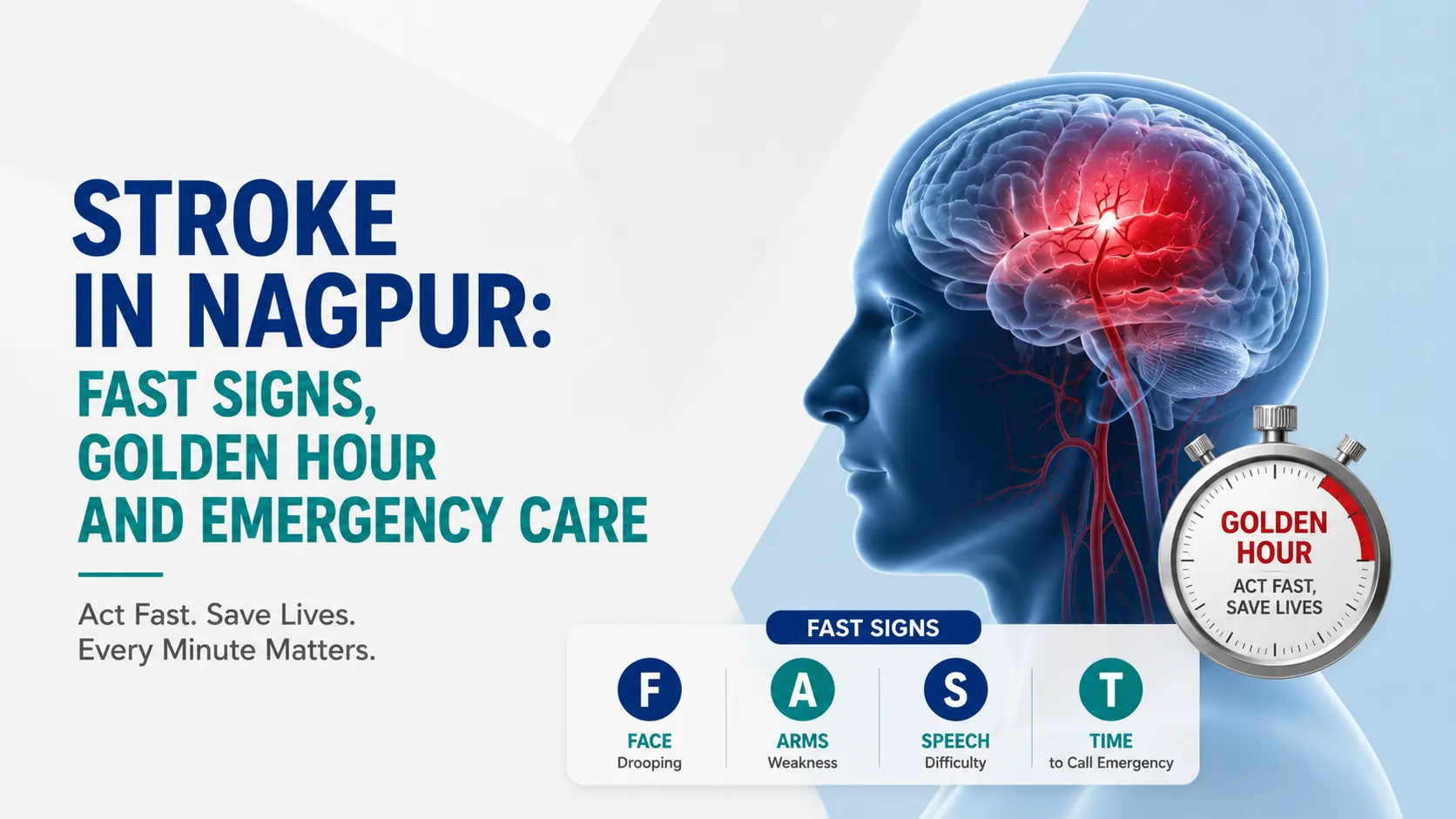
FAST is the internationally used mnemonic for recognising stroke symptoms. It stands for Face, Arms, Speech, and Time. Learning it and acting on it immediately is the single most powerful thing a bystander can do in a stroke emergency.
Face. Ask the person to smile. Does one side of the face droop or appear uneven? Facial asymmetry, especially sudden and one-sided, is a classic early warning sign of stroke.
Arms. Ask the person to raise both arms. Does one arm drift downward or feel weak? Sudden unilateral arm weakness or numbness, particularly when it comes on without any injury, is a strong signal.
Speech. Ask the person to repeat a simple sentence. Is the speech slurred, strange, or impossible to understand? Does the person struggle to find words? Sudden speech difficulty, including inability to speak, garbled speech, or difficulty understanding others, is one of the most consistent stroke symptoms.
Time. Time to call for emergency help. Note the exact time when symptoms began. This information directly determines which treatments are available. Do not drive yourself. Do not give food or water. Call for help and get to a stroke-capable hospital immediately.
Two additional warning signs that FAST does not capture but that patients and families in Nagpur should know: sudden severe headache described as the worst headache of one’s life, which may indicate a haemorrhagic stroke, and sudden loss of vision in one or both eyes or sudden severe dizziness and loss of balance, which may reflect a stroke in the posterior circulation of the brain. Any of these appearing suddenly and without obvious cause are emergencies.
The Golden Hour: Why the Clock Starts the Moment Symptoms Begin
The 2026 Guideline for the Early Management of Patients with Acute Ischaemic Stroke, published by the American Heart Association and American Stroke Association and representing the most current comprehensive evidence in stroke care,
affirms the use of intravenous thrombolytic therapy within 4.5 hours of symptom onset for eligible patients. Both alteplase and tenecteplase are endorsed as effective clot-dissolving medications. Tenecteplase, a genetically modified variant of alteplase, received FDA approval in March 2025and is gaining widespread use as a single-dose alternative that simplifies administration in time-sensitive settings. [2] [3]
But within that 4.5-hour window, time still matters enormously. A systematic review and meta-analysis published in the Annals of Neurology in June 2024, involving 78,826 stroke patients across seven studies, found that
golden hour thrombolysis was associated with higher odds of 90-day excellent functional outcomes compared with thrombolysis outside the golden hour. The number needed to treat to benefit for golden hour thrombolysis to reduce disability by at least one level on the modified Rankin Scale per patient was 2.6.To translate that finding into plain language: patients who received clot-dissolving treatment within the first hour after stroke onset were significantly more likely to walk out of hospital with minimal or no disability compared to patients treated in hour two, three, or four. Every hour of treatment delay meaningfully reduces the probability of a good outcome.
For mechanical thrombectomy, where a catheter is used to physically extract a large clot from a brain artery, the treatment window extends to 24 hours in select patients using advanced imaging to confirm the presence of salvageable brain tissue.
The 2026 Acute Ischaemic Stroke Guidelines endorse extended window thrombolysis in select patients with unknown onset or between 4.5 and 24 hours from onset using advanced imaging criteria.What this means practically for Nagpur patients is that even if a stroke is recognised late, getting to a hospital with CT imaging and a neurology team without further delay is still the right action. The window is not always closed.
Stroke Risk Factors Most Common in Nagpur
Understanding who is at highest risk helps families in Nagpur take preventive action before an emergency occurs.
Hypertension is the single most powerful modifiable risk factor for stroke globally and in India. High blood pressure damages arterial walls over years, making them vulnerable to clot formation and rupture. In an observational study of 310 acute stroke patients published in BMC research in 2025, hypertension was present in 72.6 percent of patients and diabetes mellitus in 44.5 percent, both at rates that reflect the Nagpur population accurately. [5]
Atrial fibrillation, an irregular heart rhythm that allows blood to pool and clot in the heart before travelling to the brain, is a major and underdiagnosed cause of stroke, particularly in older adults. Uncontrolled diabetes, high LDL cholesterol, tobacco use, excessive alcohol, physical inactivity, and a previous TIA (transient ischaemic attack) are all meaningful risk factors.
A TIA, sometimes called a mini-stroke, produces stroke symptoms that resolve within minutes to hours without permanent damage. It is not something to dismiss as a false alarm. A TIA is a serious warning that a major stroke may follow within days, and it requires urgent evaluation and treatment to prevent it.
Ischaemic Stroke vs Haemorrhagic Stroke: Why the Difference Matters for Treatment
This distinction matters because the treatment for one type is dangerous in the other.
Ischaemic stroke is caused by a clot blocking a brain artery. Treatment involves dissolving or removing the clot through thrombolysis or thrombectomy.
Haemorrhagic stroke is caused by a burst blood vessel bleeding into or around the brain. Blood thinners and clot-dissolving drugs used in ischaemic stroke would make a haemorrhagic stroke catastrophically worse.
A CT scan of the head, which can be completed in minutes at a hospital, is what separates the two. This is why getting to a hospital is the irreplaceable first step. No home test, no phone consultation, and no waiting to see if symptoms improve can substitute for a CT scan in the first hour after stroke symptoms begin.
What Happens at Alright Hospital When a Stroke Patient Arrives
When a patient with suspected stroke arrives at Alright Hospital’s emergency department in Jafar Nagar, the clinical team immediately initiates the acute stroke protocol. This involves a rapid clinical assessment using validated stroke scales, immediate CT imaging to distinguish ischaemic from haemorrhagic stroke, blood tests, blood pressure monitoring, and a neurology review.
For eligible ischaemic stroke patients within the treatment window, thrombolysis with alteplase or tenecteplase is initiated as quickly as possible after CT confirms no bleeding. For patients with large vessel occlusion requiring mechanical thrombectomy, the team coordinates urgent transfer to the appropriate endovascular facility if not available on-site.
After the acute phase, stroke patients at Alright Hospital receive structured inpatient monitoring, early physiotherapy assessment, and a plan for secondary prevention, meaning the medications, blood pressure control, and lifestyle modifications that reduce the risk of a second stroke.
What to Do If Someone Around You Is Having a Stroke
Note the exact time symptoms began. This is the first thing the emergency team will ask.
Call for emergency assistance immediately. Do not wait to see if the symptoms improve. TIA symptoms that resolve on their own in minutes are still a reason to go to hospital today, not tomorrow.
Do not give the person anything to eat or drink. Stroke can cause swallowing problems and aspiration is a serious risk.
Do not let the person sleep it off. Do not drive them yourself if any delay would result. Get them to the nearest stroke-capable hospital as fast as safely possible.
If the person is unconscious or has stopped breathing, begin CPR if you are trained and call for emergency help simultaneously.
Alright Hospital’s emergency department at Jafar Nagar, Nagpur, is equipped to receive and evaluate acute stroke patients with CT imaging and neurology support. For appointments, non-emergency neurology consultations, and stroke prevention evaluations, both the Jafar Nagar and Lashkaribagh branches are available.
Sources and References
[1] Khandelwal A, Sarma K, Hussain M, Dikshit P, Baidya D. Acute ischaemic stroke and the golden hour: Critical updates. Journal of Neurosciences in Rural Practice. 2025;16:152-9. doi: 10.25259/JNRP_17_2025. https://ruralneuropractice.com/acute-ischemic-stroke-and-the-golden-hour-critical-updates/
[2] American Heart Association / American Stroke Association. 2026 Guideline for the Early Management of Patients with Acute Ischaemic Stroke. Stroke. January 2026. https://www.ahajournals.org/doi/10.1161/STR.0000000000000513
[3] Cardiometabolic Health. New 2026 Acute Ischaemic Stroke Guideline: What Clinicians Need to Know. June 4, 2026. https://www.cardiometabolichealth.org/new-2026-acute-ischemic-stroke-guideline-what-clinicians-need-to-know/
[4] Ringleb P et al. Golden Hour Intravenous Thrombolysis for Acute Ischaemic Stroke: A Systematic Review and Meta-Analysis. Annals of Neurology. June 2024. DOI: 10.1002/ana.27007. https://onlinelibrary.wiley.com/doi/abs/10.1002/ana.27007
[5] PMC. Optimising Stroke Pathways: An Observational Audit of Door-to-CT Time, Thrombolysis, and Clinical Outcomes. 2025. https://www.ncbi.nlm.nih.gov/pmc/articles/PMC12712351/