

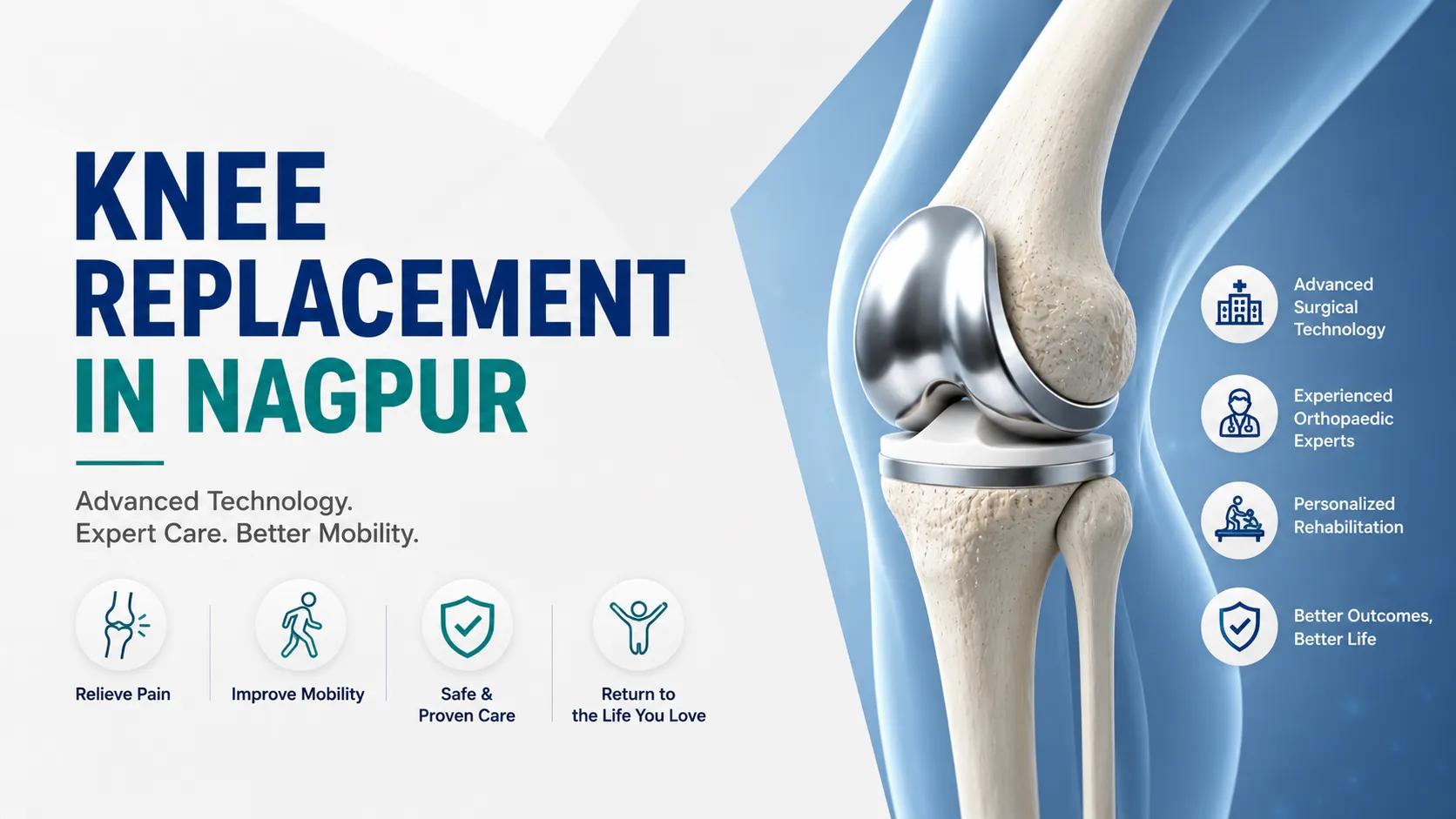
If chronic knee pain is stopping you from walking comfortably, climbing stairs, or enjoying everyday life, knee replacement surgery may be the solution. Modern knee replacement procedures have transformed the lives of thousands of patients by relieving pain, restoring mobility, and helping them return to an active lifestyle. In Nagpur, experienced orthopaedic surgeons and advanced surgical techniques have made the procedure safer, more precise, and highly successful, with success rates exceeding 95% for appropriately selected patients.
- Knee replacement is recommended when severe knee pain and stiffness no longer respond to medicines or physiotherapy.
- Most patients begin walking with assistance within 24 hours after surgery.
- The cost of knee replacement in Nagpur generally ranges from ₹1.2 lakh to ₹4 lakh, depending on the procedure and implant.
- Modern implants commonly last 15–20 years with proper care.
- Physiotherapy and rehabilitation are essential for achieving the best long-term results.
Living with Knee Pain Isn’t Just Uncomfortable—It Changes Your Life
Many people assume knee pain is simply part of getting older.
It isn’t.
At Alright Hospital, one of the most common things patients say during their first consultation is:
“I thought I could manage it for another year.”
Then they describe avoiding family weddings because standing hurts, skipping morning walks they once loved, or asking someone else to carry groceries because even a few steps have become exhausting.
That gradual loss of independence often affects more than physical health. It impacts confidence, sleep, social life, and emotional well-being.
The good news?
Today’s knee replacement surgery is far more advanced than it was even a decade ago. Better implants, improved pain management, minimally invasive techniques, and robotic-assisted procedures now help patients recover faster and enjoy excellent long-term outcomes.
The important question isn’t whether knee replacement is a good procedure.
It’s whether it’s the right time for you.
What Is Knee Replacement Surgery?
Knee replacement surgery, also known as knee arthroplasty, is a procedure that replaces damaged portions of the knee joint with specially designed artificial components made from high-quality metal alloys, medical-grade plastic, or ceramic materials.
Rather than replacing the entire leg joint, the surgeon removes the worn-out cartilage and damaged bone surfaces before positioning precision-engineered implants that recreate smooth joint movement.
The objective is straightforward:
- Relieve chronic pain
- Restore joint function
- Improve mobility
- Correct deformity
- Help patients return to everyday activities with greater comfort
For many people, the biggest benefit isn’t simply walking again.
It’s getting their normal life back.
Who Actually Needs Knee Replacement Surgery?
Not everyone with knee pain requires surgery.
In fact, experienced orthopaedic surgeons almost always recommend non-surgical treatments first. These may include medication, lifestyle modifications, physiotherapy, weight management, injections, or supportive braces.
Surgery becomes an option only when these treatments no longer provide meaningful relief.
Signs You May Need Knee Replacement
Several symptoms suggest that the knee joint has reached a stage where replacement may offer the best long-term solution.
1. Persistent Knee Pain That Doesn’t Improve
Occasional discomfort after exercise is common.
Constant pain isn’t.
If your knee hurts throughout the day—even during simple activities such as walking through your home or standing while cooking—it may indicate advanced joint damage.
Many patients eventually begin organising their entire day around avoiding pain.
That’s usually a sign that further evaluation is needed.
2. Pain That Interrupts Sleep
This surprises many people.
Advanced arthritis doesn’t always stop hurting when you rest.
Patients often describe waking several times each night because they cannot find a comfortable sleeping position.
Night pain is frequently a sign that cartilage loss has become severe.
3. Stiffness That Limits Daily Activities
Can you comfortably:
- Bend your knee?
- Sit cross-legged?
- Get into a car?
- Climb stairs?
- Stand up from a chair without assistance?
If the answer is “no” to several of these questions, joint stiffness may be significantly affecting your quality of life.
4. Swelling That Never Fully Goes Away
Temporary swelling after activity is relatively common.
Persistent swelling that remains despite medication, rest, or ice therapy often indicates ongoing inflammation inside the joint.
Over time, this inflammation contributes to cartilage deterioration.
5. Grinding or Clicking Inside the Knee
Some people notice a rough grinding sensation every time they bend the knee.
Doctors call this crepitus.
It often develops because the protective cartilage has worn away, allowing bone surfaces to rub against each other.
Patients frequently describe it as feeling like “sandpaper inside the knee.”
6. Bowed Legs or Knee Deformity
As arthritis progresses, the alignment of the knee may begin to change.
The legs may gradually become:
- Bow-legged (varus deformity)
- Knock-kneed (valgus deformity)
Besides affecting appearance, these changes alter weight distribution across the joint, accelerating further damage.
7. Your Knee Feels Unstable
Some patients say:
“I never know when my knee might give way.”
Instability increases the risk of falls and can make walking feel unpredictable and unsafe.
What Causes Severe Knee Damage?
Understanding the underlying cause helps determine the most appropriate treatment plan.
Osteoarthritis
This is the most common reason people undergo knee replacement surgery.
Over many years, the protective cartilage gradually wears away. As cushioning disappears, bones begin rubbing together, causing pain, stiffness, and inflammation.
Age is one factor, but obesity, previous injuries, genetics, and repetitive stress can also contribute.
Rheumatoid Arthritis
Unlike osteoarthritis, rheumatoid arthritis is an autoimmune disease.
Instead of normal wear and tear, the body’s immune system mistakenly attacks the lining of the joint.
Over time, chronic inflammation damages cartilage, ligaments, and surrounding bone.
Without appropriate treatment, joint destruction can become severe.
Post-Traumatic Arthritis
Sometimes the damage begins with an accident rather than ageing.
A fractured knee, ligament injury, or torn meniscus may permanently change how the joint functions.
Even after the initial injury heals, abnormal joint mechanics can accelerate arthritis over the following years.
Many patients don’t connect an injury from 15 or 20 years ago with the pain they’re experiencing today—but orthopaedic specialists see this pattern regularly.
Avascular Necrosis
Although less common, avascular necrosis can rapidly destroy the knee joint.
This condition occurs when the blood supply to part of the bone becomes disrupted.
Without adequate circulation, bone tissue weakens and eventually collapses, damaging the joint surface.
In many cases, surgery becomes the most effective treatment once significant collapse has occurred.
Is It Better to Have Surgery Early or Wait?
This is probably the question orthopaedic surgeons hear most often.
Many patients understandably want to postpone surgery.
Sometimes that’s reasonable.
Sometimes it isn’t.
If pain remains manageable and daily activities are largely unaffected, continuing with conservative treatment may be appropriate.
However, delaying surgery for too long can create additional problems.
As knee deformity worsens, muscles weaken, mobility decreases, and rehabilitation after surgery may become more challenging.
Rather than asking:
“How old am I?”
A better question is:
“How much is my knee limiting my life?”
That’s often the deciding factor.
A Quick Patient Example
A 66-year-old retired teacher visited Alright Hospital after living with knee pain for nearly six years.
She had tried painkillers, injections, physiotherapy, herbal remedies, and knee braces.
Nothing provided lasting relief.
She had stopped attending family functions because standing for more than ten minutes became unbearable.
Following a thorough evaluation, she underwent total knee replacement.
The morning after surgery, she stood with assistance and took her first few supported steps using a walker.
Within six weeks, she was comfortably walking around her neighbourhood again and had returned to many of the activities she had gradually given up.
Her story isn’t unusual.
For appropriately selected patients, knee replacement often restores not only movement—but confidence and independence.
What Does Knee Replacement Cost in Nagpur?
One of the first questions patients ask is, “How much will knee replacement surgery cost?”
The answer depends on several factors, including the type of procedure, the implant selected, the surgical technology used, and the hospital facilities.
While price is important, it’s equally important to consider the surgeon’s experience, the quality of implants, rehabilitation support, and long-term outcomes. Choosing surgery based solely on the lowest price can sometimes lead to higher costs later if complications arise or revision surgery becomes necessary.
Estimated Knee Replacement Cost in Nagpur
| Procedure | Estimated Cost |
|---|---|
| Partial Knee Replacement (PKR) | ₹1.2 lakh – ₹2 lakh |
| Standard Total Knee Replacement (TKR) | ₹1.5 lakh – ₹2.5 lakh |
| Robotic-Assisted Knee Replacement | ₹2.5 lakh – ₹4 lakh |
| Bilateral Knee Replacement | ₹3.5 lakh – ₹6 lakh+ |
These figures are approximate and may vary depending on the patient’s condition, implant choice, and hospital package.
What Is Included in the Cost?
Most knee replacement packages generally include:
- Orthopaedic surgeon’s fees
- Anaesthesia charges
- Operating theatre expenses
- Standard hospital stay (typically 4–5 days)
- Nursing care
- Routine medications during admission
- Basic physiotherapy sessions
- Standard implants (depending on package)
Additional expenses may include:
- Advanced imaging (MRI or CT scan if required)
- Blood investigations
- Premium imported implants
- Extended hospital stay
- Additional physiotherapy after discharge
A detailed estimate after clinical evaluation helps patients understand exactly what is included before surgery.
Robotic Knee Replacement vs Conventional Surgery
Robotic-assisted knee replacement has become increasingly popular because it offers greater precision during surgery.
That said, robots don’t perform the operation independently.
The surgeon remains in complete control throughout the procedure, using robotic guidance to improve implant positioning and alignment.
Advantages of Robotic Knee Replacement
- More accurate implant placement
- Better bone preservation
- Improved joint alignment
- Smaller margin of surgical error
- Potentially faster functional recovery
- Better long-term implant performance in selected patients
Conventional knee replacement, however, also delivers excellent outcomes when performed by an experienced orthopaedic surgeon.
The most appropriate option depends on each patient’s anatomy, degree of arthritis, and overall health.
Does Health Insurance Cover Knee Replacement?
In many cases, yes.
Most major insurance providers cover knee replacement surgery when it is medically indicated.
Patients may also be eligible under government healthcare schemes such as:
- Ayushman Bharat (PM-JAY)
- CGHS
- Other approved state or employer-sponsored health insurance programmes
At Alright Hospital, the admissions and insurance team can help patients understand their eligibility, documentation requirements, and available cashless treatment options before surgery.
What Recovery Really Looks Like
One of the biggest misconceptions about knee replacement is that patients remain bedridden for weeks.
Thankfully, modern rehabilitation has changed that dramatically.
Today, early mobilisation is considered one of the keys to successful recovery.
First 24–72 Hours
Most patients:
- Stand with support within 24 hours
- Begin walking using a walker
- Start gentle knee-bending exercises
- Receive supervised physiotherapy
- Learn safe techniques for sitting, standing, and using stairs
Early movement helps reduce complications such as blood clots and stiffness while building confidence from the very beginning.
Weeks 1–3
During this stage, the focus shifts towards improving flexibility and restoring basic independence.
Patients usually:
- Continue home physiotherapy
- Increase walking distance gradually
- Improve knee bending
- Manage swelling with icing and elevation
- Have stitches removed around days 13–21
Consistency matters more than intensity during these first few weeks.
Weeks 4–6
Many patients notice significant improvements.
Most can:
- Walk independently
- Drive again (after medical clearance)
- Return to office-based work
- Perform everyday household activities
- Climb stairs more comfortably
Although recovery varies from person to person, this stage is often when patients begin appreciating how much their pain has reduced.
Three to Six Months
This is when strength and endurance continue improving.
Many patients return to:
- Longer walks
- Shopping independently
- Travelling
- Gardening
- Light recreational activities
- Social gatherings
The artificial joint begins feeling increasingly natural as muscles strengthen around it.
Up to One Year
Healing continues long after the surgical wound has disappeared.
By twelve months:
- Swelling is usually minimal
- Walking becomes effortless for most patients
- Muscle strength approaches normal
- Confidence improves considerably
Modern knee implants commonly last 15–20 years, and often even longer when patients maintain a healthy weight, stay active, and follow their surgeon’s recommendations.
Why Physiotherapy Is Just As Important As Surgery
Surgery repairs the joint.
Physiotherapy teaches your body how to use it again.
Patients who actively participate in rehabilitation generally recover faster, regain better flexibility, and achieve higher satisfaction with their results.
A typical rehabilitation programme includes:
- Range-of-motion exercises
- Quadriceps strengthening
- Hamstring strengthening
- Balance training
- Walking practice
- Stair training
- Functional movement exercises
Skipping physiotherapy can delay recovery and increase stiffness.
Simply put, surgery and rehabilitation work hand in hand.
Are There Any Risks?
Every surgical procedure carries some degree of risk.
Fortunately, serious complications following knee replacement are relatively uncommon when surgery is performed by experienced specialists in an appropriately equipped hospital.
Potential risks include:
- Infection
- Blood clots
- Implant loosening
- Persistent stiffness
- Nerve or blood vessel injury
- Continued pain in rare cases
Patients can reduce these risks by:
- Following medical advice carefully
- Taking prescribed medications
- Attending physiotherapy regularly
- Maintaining good diabetes control if applicable
- Avoiding smoking before and after surgery
Benefits of Knee Replacement
For appropriately selected patients, the benefits often outweigh the risks.
Most patients experience:
- Significant pain relief
- Better walking ability
- Improved sleep
- Increased independence
- Easier stair climbing
- Greater confidence
- Enhanced quality of life
- Long-lasting improvement in mobility
Many patients say they wish they had not waited so long before seeking treatment.
Is Knee Replacement Right for You?
You may benefit from an orthopaedic consultation if you:
✔ Have severe knee pain every day
✔ Experience pain while resting or sleeping
✔ Cannot climb stairs comfortably
✔ Have difficulty walking short distances
✔ Depend on painkillers regularly
✔ Notice bowed legs or knee deformity
✔ Have tried physiotherapy without lasting relief
✔ Have arthritis confirmed on X-rays
An evaluation by an orthopaedic specialist helps determine whether surgery—or continued non-surgical treatment—is the most appropriate option.