

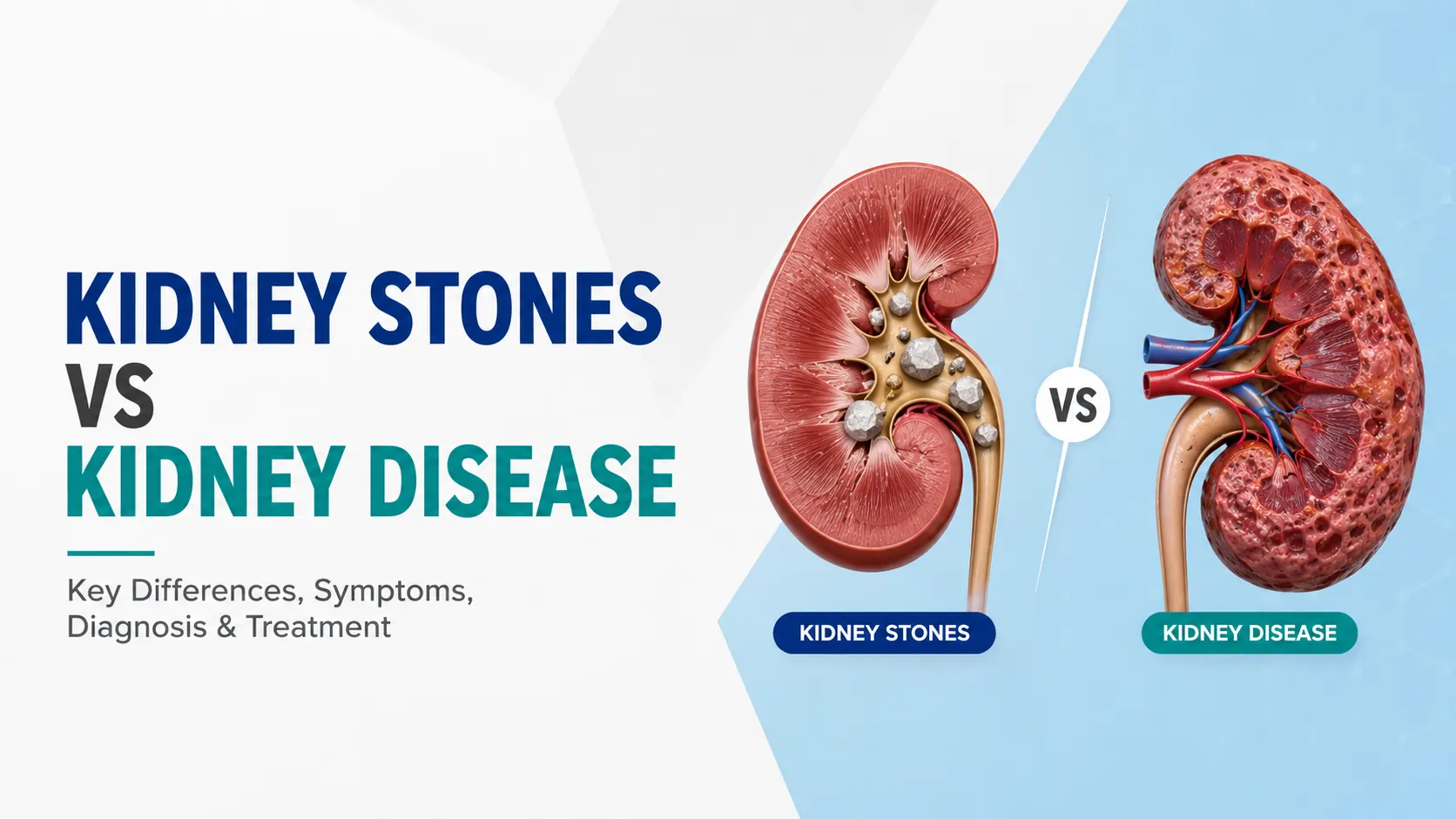
Kidney stones cause sudden severe cramping pain in the side or back and are visible on ultrasound. They are treatable and rarely cause permanent damage. Chronic kidney disease (CKD) causes gradual, often silent decline in kidney function that shows in blood tests as elevated creatinine and requires long-term specialist management. Both need nephrologist evaluation at Alright Hospital Nagpur.
Why Both Conditions Cause Similar Symptoms
A large number of patients who walk into a nephrology consultation in Nagpur use the same word to describe two very different problems: “kidney pain.” This is understandable. Both kidney stones and chronic kidney disease can produce discomfort in the same general region of the body, the flanks and lower back, and both can be accompanied by changes in urination. But beneath that shared symptom, the two conditions are almost opposites in how they behave.
A kidney stone is a sudden, mechanical, localised event. It announces itself loudly and acutely. Chronic kidney disease, in contrast, is a slow functional decline that often produces no symptoms at all until a significant portion of kidney function has already been lost. Confusing the two, or assuming that the absence of dramatic pain means the kidneys are fine, is one of the most common and consequential misunderstandings in patient self-assessment.
This guide is written to clear up that confusion so that you know exactly what symptom pattern points to which condition, and more importantly, when to seek nephrology care in Nagpur without delay.
What Are Kidney Stones?
Kidney stones, medically called nephrolithiasis or renal calculi, are hard mineral and salt deposits that form inside the kidney when urine becomes concentrated, allowing minerals to crystallise and stick together. They can range from the size of a grain of sand to, in rare cases, a golf ball.
The classic symptom is renal colic, a severe, often excruciating pain that begins suddenly in the back or side, below the ribs, and may move toward the lower abdomen and groin as the stone travels down the ureter. The pain typically comes in waves, fluctuating in intensity rather than remaining constant, and is frequently accompanied by nausea, vomiting, and visible blood in the urine. Burning during urination and a frequent urge to urinate occur when the stone nears the bladder.
Most kidney stones are caused by insufficient fluid intake, a diet high in salt and animal protein, obesity, certain metabolic conditions, and in some cases a family history of stone formation. Nagpur’s hot climate for much of the year is a genuine contributing factor, since reduced fluid intake and increased sweating concentrate the urine and promote crystal formation.
The encouraging fact about kidney stones is that, once treated, they rarely cause lasting damage to kidney function in patients without underlying structural or metabolic abnormalities.
What Is Kidney Disease (CKD)?
Chronic kidney disease is a fundamentally different process. It is defined as a progressive disorder characterised by the gradual and irreversible decline in renal structure and function, identified by evidence of kidney damage or a sustained reduction in glomerular filtration rate (GFR) below 60 millilitres per minute per 1.73 m squared for longer than three months.
Unlike a kidney stone, CKD does not announce itself with a dramatic pain episode. In its early stages, stage 1 through stage 3, most patients feel completely normal. The kidneys are remarkably good at compensating for gradual loss of function, which means by the time symptoms like fatigue, swelling in the legs, reduced appetite, or changes in urine output appear, a significant portion of kidney function may have already been lost.
CKD in India and in the Nagpur region is most commonly caused by long-standing diabetes and high blood pressure, both of which damage the small blood vessels and filtering units inside the kidney over years. Chronic use of painkillers, recurrent kidney infections, and untreated obstruction from stones can also contribute over time.
This is the central danger of CKD: it is a quiet disease until it is a loud one, and by the time it becomes loud, treatment options narrow considerably.
How to Tell the Difference: Symptoms, Tests, and Imaging
The clearest way to separate the two conditions is to look at the pattern of onset, the nature of any pain, and what diagnostic tests reveal.
Onset and Pain Pattern. Kidney stones cause an acute, severe, often unbearable pain that arrives suddenly, frequently in the middle of the night or without warning, and changes location as the stone moves. CKD typically causes no specific pain at all. When discomfort does occur in CKD, it tends to be a dull, vague heaviness rather than a sharp colicky pain, and is far less common as a presenting symptom than fatigue or swelling.
Urine Tests. A urinalysis in kidney stone disease often shows blood, sometimes visible to the naked eye, along with crystals. In CKD, the urine test of greatest importance is the urine albumin-to-creatinine ratio, which detects protein leaking from damaged kidney filters, often well before any blood test abnormality appears.
Blood Tests. Kidney stones generally do not raise serum creatinine unless they are causing a significant obstruction affecting kidney drainage. CKD is defined in large part by a sustained elevation in serum creatinine and a correspondingly reduced eGFR. One important clinical nuance worth understanding is that the relationship between creatinine and kidney function is not linear. A creatinine increase even within what looks like a normal range can actually reflect a loss of more than 50 percent of kidney function, which is why eGFR rather than creatinine alone is used for accurate assessment.
Ultrasound Imaging. This is where the two conditions look distinctly different to a radiologist. A kidney stone appears on ultrasound as a bright, well-defined echogenic focus, often with a posterior acoustic shadow, sometimes accompanied by dilation of the collecting system if it is obstructing urine flow. CKD, in contrast, shows a different pattern entirely: increased cortical echogenicity, reduced kidney length, loss of the normal corticomedullary distinction, and in advanced stages, visible kidney atrophy and parenchymal thinning. Research has consistently shown that higher renal echogenicity on ultrasound correlates with higher serum creatinine levels, meaning the kidney’s appearance on a scan tracks meaningfully with how well it is actually functioning.
Ultrasound is considered the diagnostic tool of choice for both conditions because it is noninvasive, free of radiation, and widely available, making it the ideal first step in differentiating between an acute stone and chronic structural kidney change.
Treatment for Kidney Stones in Nagpur
Treatment depends primarily on the size of the stone and whether it is causing obstruction or infection.
Small stones, generally under 5 millimetres, often pass on their own with increased fluid intake and pain management, sometimes assisted by medication that relaxes the ureter. Stones between 5 and 10 millimetres may require similar conservative management with closer monitoring, or a procedure if they fail to pass within a reasonable time.
Larger stones, or those causing significant obstruction, infection, or unrelenting pain, typically require intervention. The two most common procedures are extracorporeal shock wave lithotripsy (ESWL), which uses focused shock waves from outside the body to break the stone into smaller fragments that can pass naturally, and ureteroscopy, a minimally invasive procedure where a thin scope is passed through the urinary tract to remove or fragment the stone directly. For very large stones, percutaneous nephrolithotomy (PCNL) may be required.
At Alright Hospital, our urology and nephrology teams work together to determine which approach best fits your stone size, location, and overall kidney health, and to investigate any underlying metabolic cause to reduce the chance of recurrence.
Treatment for CKD: Dialysis and Beyond
CKD management looks entirely different because the goal is not to remove an obstruction but to slow the rate of decline and protect remaining kidney function for as long as possible.
In the early and moderate stages, treatment centres on tightly controlling the underlying cause, most often diabetes and high blood pressure, alongside dietary modification, careful medication review to avoid kidney-harming drugs, and regular monitoring of eGFR and urine albumin. Medications including SGLT-2 inhibitors and certain blood pressure drugs have demonstrated meaningful kidney-protective effects in clinical studies and are increasingly part of standard CKD management.
In advanced CKD, stage 4 and stage 5, the focus shifts to preparing for and managing kidney failure. This may eventually involve dialysis, either haemodialysis, which filters the blood through a machine typically three times a week, or peritoneal dialysis, which uses the lining of the abdomen to filter waste continuously at home. For eligible patients, kidney transplantation offers the possibility of returning to a fuller quality of life. Dialysis services and CKD management are available in Nagpur, and the earlier a patient is brought under specialist nephrology care, the more options remain available to them as the disease progresses.
When Must I See a Nephrologist?
You should seek nephrology evaluation promptly if you experience sudden, severe flank pain that does not improve, especially with nausea, fever, or visible blood in the urine, since this pattern suggests a kidney stone that may need urgent attention.
You should also seek evaluation, even without any pain at all, if you have diabetes or high blood pressure and have not had your kidney function checked in the past year, if you notice persistent swelling in your legs or face, unusual and unexplained fatigue, foamy urine, or a family history of kidney failure. These are the patients in whom CKD most often hides quietly until it has already progressed.
At Alright Hospital, our nephrology team in Nagpur evaluates both acute stone presentations and long-term kidney function monitoring at the Jafar Nagar and Lashkaribagh branches. Whether your concern is a sudden episode of pain or a routine blood test result that raised a question, early evaluation is always the right decision.
Sources and References
[1] PMC. Role of Ultrasound in the Diagnosis of Chronic Kidney Disease and its Correlation with Serum Creatinine Level. National Center for Biotechnology Information. https://pmc.ncbi.nlm.nih.gov/articles/PMC6516621/
[2] Zhao L et al. Quantifying Ultrasound Echogenicity Difference for Accurate Chronic Kidney Disease Diagnosis. Journal of Nephrology. 2025 Nov;38(8):2353-2362. https://pubmed.ncbi.nlm.nih.gov/40739378/
[3] Dahmardeh H et al. Correlation Between Ultrasound Findings and Serum Creatinine Level in CKD Patients. Zahedan Journal of Research in Medical Sciences. 2025;27(3):e162369. https://brieflands.com/journals/zjrms/articles/162369
[4] Nature npj Imaging. Advanced Ultrasound Methods to Improve Chronic Kidney Disease Diagnosis. 2024. https://www.nature.com/articles/s44303-024-00023-5
[5] LivHospital. 7 Key Signs of Chronic Kidney Disease on Ultrasound. Updated April 2026. https://int.livhospital.com/7-key-signs-of-chronic-kidney-disease-on-ultrasound/