
Gallstones are hardened deposits in the gallbladder that cause episodes of severe upper-right abdominal pain, often triggered by fatty meals, and are diagnosed by ultrasound. Laparoscopic cholecystectomy (keyhole gallbladder removal) at Alright Hospital Nagpur takes about 45 minutes and allows most patients to go home within 24 hours.
What Are Gallstones?
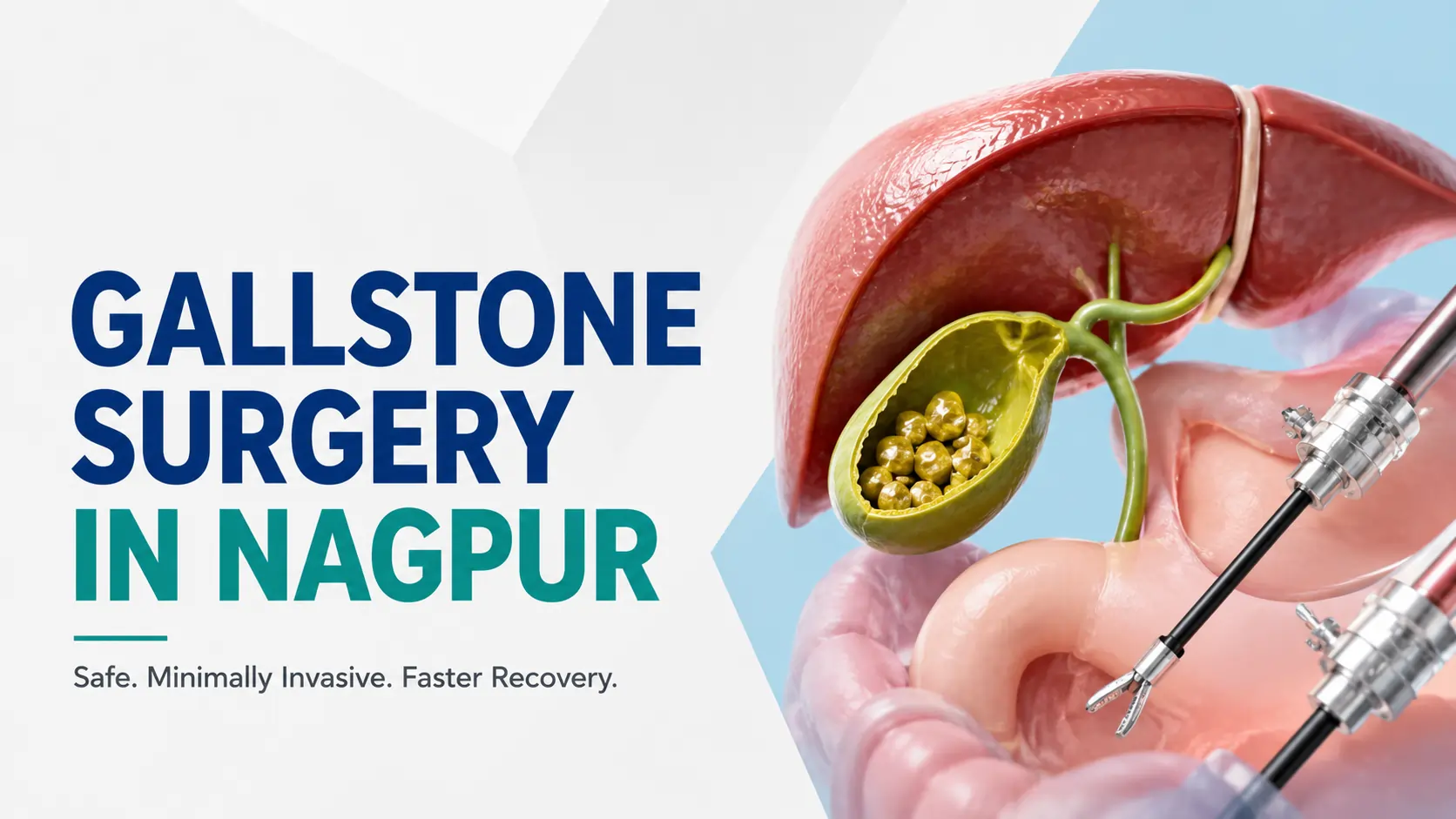
The gallbladder is a small pouch tucked beneath the liver on the right side of your abdomen. Its job is to store bile, the digestive fluid the liver produces to break down fat. When bile becomes oversaturated with cholesterol or certain waste products, it can crystallise inside the gallbladder and form stones. These are gallstones.
Gallstones are one of the most common clinical findings in abdominal medicine. The majority of patients are entirely asymptomatic. However, some experience symptoms ranging from intensifying abdominal pain to nausea or vomiting. Gallstones can be pure cholesterol, which account for the majority, or mixed cholesterol and pigment stones.
The prevalence of gallstone disease is estimated to be around 10 to 15 percent in the adult population of developed countries, with variations based on geographic region, ethnicity, and diet. In India, dietary patterns and genetic predisposition make gallstones increasingly common across age groups, including in women in their thirties and forties.
Advanced age, female sex, a high-calorie diet, obesity, and genetic factors are the most important predisposing factors. In Nagpur, patients with diabetes and those who have undergone rapid weight loss are also at higher risk, as both conditions affect bile composition and gallbladder motility.
Recognising Gallstone Symptoms
Most gallstones never cause symptoms and are discovered incidentally during an ultrasound done for another reason. But when a stone blocks the outlet of the gallbladder, the symptoms that follow are hard to ignore.
Patients typically present with right upper quadrant or epigastric pain, classically occurring after ingestion of fatty meals and radiating to the right shoulder or back. This pain, called biliary colic, often builds over 15 to 30 minutes, peaks with intensity, and then slowly fades over a few hours. It is not the same as heartburn or regular acidity, and antacids do not relieve it.
Other symptoms that accompany gallstone episodes include nausea and vomiting, a bloated sensation after eating, and intolerance to fatty or fried foods. Some patients describe a feeling of pressure under the right rib cage that begins during the meal or within an hour of it.
When a gallstone causes infection of the gallbladder, a condition called acute cholecystitis, fever is added to the picture and the pain becomes more constant rather than episodic. This is an urgent situation requiring hospitalisation and prompt surgical evaluation. Jaundice, which presents as yellowing of the skin and eyes, dark urine, and pale stools, indicates a stone has moved into the common bile duct and is a complication requiring immediate attention.
If not treated in a timely manner, gallstone disease can lead to serious complications such as acute cholecystitis, gallbladder empyema, gangrene, perforation, and secondary cholangitis, posing a substantial threat to patient health.
How Gallstones Are Diagnosed
Ultrasound is the investigation of choice for gallstones. It is painless, uses no radiation, takes about fifteen minutes, and is highly accurate for detecting stones in the gallbladder. The ultrasound report will typically describe the number of stones, their size, and any thickening of the gallbladder wall that suggests inflammation.
Blood tests are ordered alongside the ultrasound. A complete blood count checks for signs of infection or inflammation. Liver function tests including bilirubin, alkaline phosphatase, ALT, and AST help determine whether a stone has affected the bile duct or liver. An elevated bilirubin or ALP raises suspicion for common bile duct involvement and may prompt further imaging such as an MRCP.
In straightforward cases, an ultrasound showing symptomatic stones and normal blood tests is sufficient to plan treatment. At Alright Hospital, our radiology and general surgery teams review findings together to make sure the clinical and imaging picture align before any surgical recommendation is made.
Can Gallstones Be Treated Without Surgery?
This is a common and entirely reasonable question. The honest answer is that non-surgical options for gallstones are limited in their usefulness.
Medications that dissolve cholesterol stones, such as ursodeoxycholic acid, exist but work only on small, cholesterol-type stones in a functioning gallbladder, take months to years to have any effect, and carry a high recurrence rate once stopped. They are rarely used in clinical practice today because surgery offers a definitive solution.
Dietary modification can reduce the frequency of symptomatic episodes by avoiding fatty meals, which are the main trigger for gallbladder contraction. However, diet does not dissolve existing stones or prevent complications.
Asymptomatic gallstones are generally not an indication for laparoscopic cholecystectomy. If your gallstones were found incidentally and have never caused symptoms, watchful waiting is a reasonable approach with regular follow-up. The decision to operate on asymptomatic stones is made case by case, factoring in stone size, gallbladder wall appearance, and patient age and risk profile.
According to the Society of American Gastrointestinal and Endoscopic Surgeons, patients with symptomatic cholelithiasis are eligible for laparoscopic surgery. Once gallstones have caused a symptomatic episode or a complication, surgery becomes the standard recommendation because recurrence is the rule, not the exception.
Laparoscopic Cholecystectomy: What Happens During Keyhole Surgery
Laparoscopic cholecystectomy is the standard treatment for symptomatic gallbladder disease. Since the early 1990s, this procedure has largely replaced open cholecystectomy due to its minimally invasive nature, offering patients less postoperative pain, shorter hospital stays, faster recovery, and lower complication rates.
Here is what the procedure involves step by step at Alright Hospital.
The patient is admitted on the morning of surgery after an overnight fast. Pre-operative blood tests, an ECG, and an anaesthetic review are completed. The procedure is performed under general anaesthesia, meaning the patient is fully asleep.
The surgeon makes three or four small incisions, each less than one centimetre, on the abdomen. A thin camera called a laparoscope is inserted through one incision, and specialised instruments through the others. Carbon dioxide gas is introduced into the abdomen to create working space. The surgeon views the entire operation on a monitor with clear, magnified visibility.
The gallbladder is carefully separated from the liver and bile duct, clipped at its neck, and removed through the incision near the navel in a small retrieval bag. The gas is released, the incisions are closed with absorbable stitches, and small dressings are applied.
The entire procedure typically takes 45 to 60 minutes for an uncomplicated case. Patients whose laparoscopic cholecystectomy is uncomplicated may be sent home the same day if postoperative pain and nausea are well controlled. Most patients at Alright Hospital are discharged within 24 hours.
Recovery After Gallbladder Removal
Recovery after laparoscopic cholecystectomy is significantly quicker than after open surgery. Most patients experience mild soreness around the incision sites and occasional shoulder discomfort from the residual gas, which settles within a day or two. Oral pain relief is usually sufficient.
Most patients are back to light daily activities within three to five days. Return to desk work is typically within one week. More physical work or exercise can resume at two to four weeks. Full recovery for most patients is complete within three to four weeks.
The gallbladder is not an essential organ. The liver produces bile continuously and after gallbladder removal it drains directly into the small intestine. Most people adjust to this without any ongoing digestive problems.
Diet After Gallbladder Surgery
In the first two weeks after surgery, a low-fat diet is advisable while the body adjusts to bile flowing directly rather than being stored. Small frequent meals are better tolerated than large ones. Foods to limit initially include fried food, full-fat dairy, red meat, and heavy curries.
Most patients return to a normal diet within four to six weeks without restrictions. A small proportion of patients experience loose stools or increased bowel frequency for several weeks after surgery, which usually resolves on its own. If symptoms persist beyond six weeks, a follow-up with the surgical team is recommended.
For a consultation with the General Surgery team at Alright Hospital regarding gallstones, appointments are available at both the Jafar Nagar and Lashkaribagh branches in Nagpur.
Sources and References
[1] StatPearls. Laparoscopic Cholecystectomy. National Center for Biotechnology Information. Updated July 2, 2025. https://www.ncbi.nlm.nih.gov/books/NBK448145/
[2] Journal of Surgical Case Reports. Laparoscopic Cholecystectomy for a Giant Gallstone. Oxford Academic. March 28, 2025. https://academic.oup.com/jscr/article/2025/4/rjaf143/8105633
[3] Frontiers in Surgery. Laparoscopic Cholecystectomy, Pain, and Quality of Life. November 17, 2025. https://www.frontiersin.org/journals/surgery/articles/10.3389/fsurg.2025.1629934/pdf
[4] Society of American Gastrointestinal and Endoscopic Surgeons (SAGES). Guidelines for the Clinical Application of Laparoscopic Biliary Tract Surgery. https://www.sages.org/publications/guidelines/guidelines-for-the-clinical-application-of-laparoscopic-biliary-tract-surgery/
[5] Medscape. Gallstones (Cholelithiasis) Treatment and Management. https://emedicine.medscape.com/article/175667-treatment
Frequently Asked Questions
What are the symptoms of gallstones?
The most common symptom of gallstones is biliary colic, which is severe pain in the upper right abdomen or epigastrium that typically develops after eating fatty food and may radiate to the right shoulder or back. The pain builds over 15 to 30 minutes and fades over a few hours. Nausea, vomiting, and fatty food intolerance are also common. Fever and jaundice indicate complications requiring urgent medical attention.
Can gallstones go away without surgery?
Asymptomatic gallstones often do not require surgery and may be managed with watchful waiting and dietary modification. However, once gallstones cause symptoms or complications, surgery is the standard treatment because recurrence is very likely without it. Medication to dissolve stones is available but works only for small cholesterol stones, takes months to years, and has a high recurrence rate, making laparoscopic surgery the preferred definitive treatment.
What is laparoscopic cholecystectomy?
Laparoscopic cholecystectomy is a minimally invasive keyhole surgery to remove the gallbladder. It is performed under general anaesthesia through three or four small incisions less than one centimetre each, using a camera and specialised instruments. The procedure takes approximately 45 to 60 minutes for uncomplicated cases and is the gold standard treatment for symptomatic gallstones globally. Most patients at Alright Hospital Nagpur are discharged within 24 hours.
How long is recovery after gallbladder removal in Nagpur?
Most patients return to light daily activities within three to five days after laparoscopic cholecystectomy. Return to desk work is typically within one week and to physical activity within two to four weeks. Full recovery is usually complete within three to four weeks. A low-fat diet is recommended for the first two weeks, after which most patients return to a normal diet without long-term restrictions.