
Rota Angioplasty, also known as rotablation, is an advanced cardiac procedure used to treat severely calcified coronary arteries that standard balloon angioplasty cannot open safely. Dr. Irshad Pathan at Alright Hospital Nagpur is one of the few MBBS, MD, DM, FESC, FACC & FSCAI-certified interventional cardiologists in Central India performing this procedure.
What Are Calcified Coronary Arteries?
Coronary arteries carry blood to the heart muscle. Over time, especially in patients with longstanding diabetes, hypertension, chronic kidney disease, or simply advancing age, calcium deposits build up inside the artery walls. These deposits harden the vessel, making it rigid and difficult to treat with conventional tools.
Calcification is graded from mild to severe. Mild calcium deposits often do not change the treatment approach significantly. But severe coronary calcification is a different problem entirely. The artery wall becomes so hard that standard balloons cannot expand properly, and forcing them risks the balloon bursting, the artery tearing, or the stent not seating correctly. Left untreated, severely calcified blockages restrict blood flow enough to cause chest pain, breathlessness on exertion, and eventually a heart attack.
Patients most likely to have calcified arteries include those above 65, long-term diabetics, those with chronic kidney disease, and anyone with a prolonged history of uncontrolled hypertension.
Why Standard Angioplasty Fails on Calcified Arteries
Standard balloon angioplasty works by inflating a small balloon inside the blocked artery to compress the plaque and create space for a stent. It is highly effective for soft or mixed plaque.
Calcified plaque is a fundamentally different material. It does not compress. When a balloon is inflated against a heavily calcified segment, it cannot achieve full expansion. An under-expanded stent is a serious problem: it traps residual stenosis, creates flow turbulence, and significantly raises the risk of stent thrombosis, meaning a clot forming inside the stent. The clinical consequence of stent thrombosis is a major heart attack.
This is why calcified coronary arteries require a different tool before any stent is placed, and that tool is rotablation.
How Rota Angioplasty (Rotablation) Works
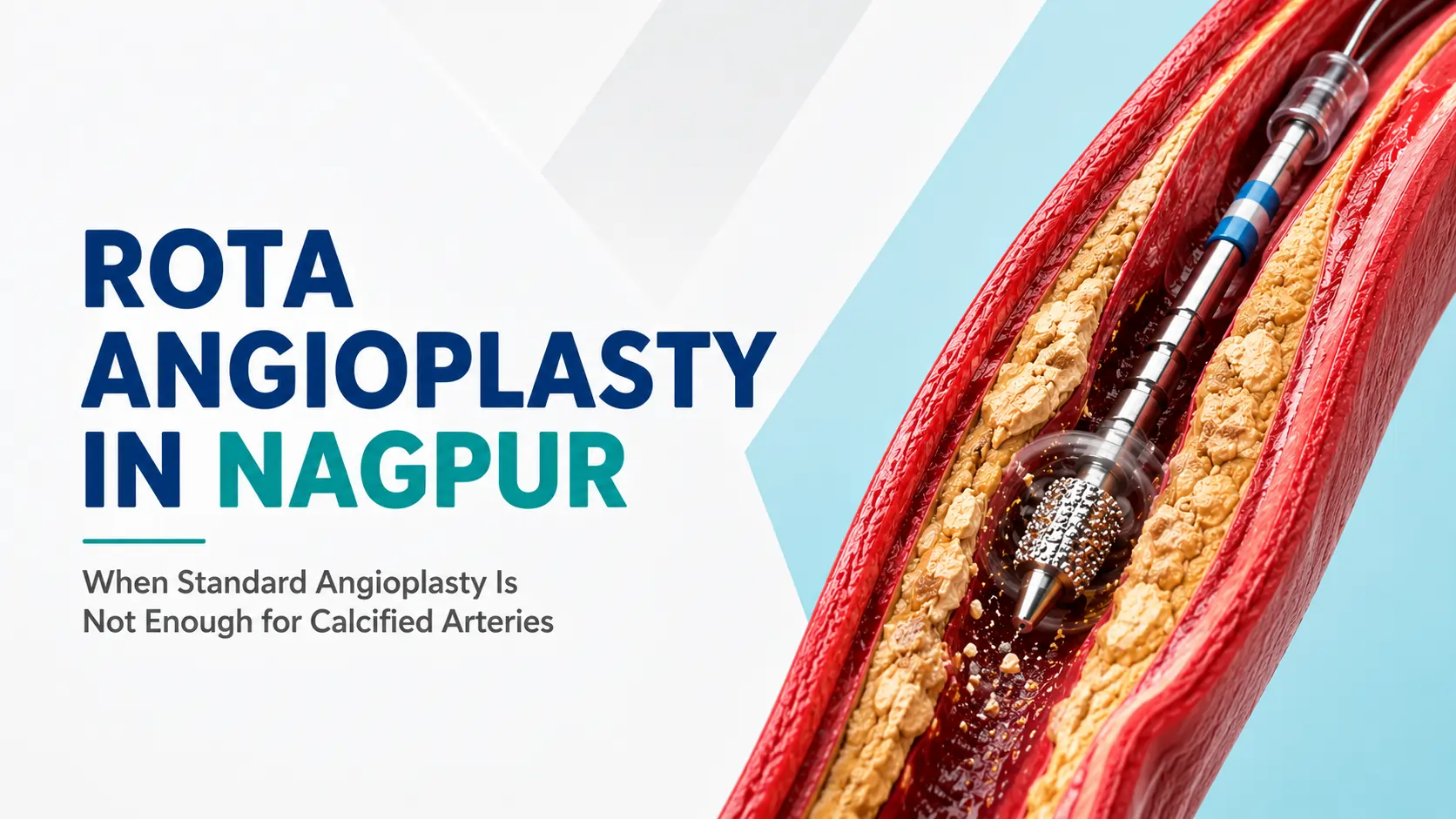
Rota Angioplasty uses a small diamond-tipped burr attached to a catheter. The burr rotates at very high speed, typically between 140,000 and 180,000 revolutions per minute, and is advanced into the calcified segment of the artery. At that speed, the burr ablates the calcium selectively, turning it into microscopic particles that are safely absorbed by the body. It does not cut soft tissue; it differentially removes only the hardened calcified material.
Once the calcium is modified and the artery is prepared, a conventional balloon and stent can be introduced with confidence that full expansion and correct stent apposition will be achieved.
The entire procedure is performed in the catheterization laboratory under X-ray guidance, through the same arterial access used for standard angioplasty, typically at the wrist. Patients remain awake under light sedation and feel no pain during the procedure.
Who Is a Candidate for Rota Angioplasty?
Not every patient with a coronary blockage needs rotablation. The decision is made after reviewing the coronary angiogram, which maps the location, severity, and morphology of the blockage.
Rota Angioplasty is considered when angiography reveals moderate to severe coronary calcification at or near the blockage site, when a trial balloon cannot be expanded to adequate diameter, or when the calcification is visible on fluoroscopy even before contrast injection, which indicates very significant calcium burden.
Patients who are most likely to benefit include those with multiple cardiovascular risk factors and longstanding disease, those who have previously had procedures that were suboptimal due to calcification, and those in whom standard stenting would carry an unacceptably high risk of failure. The decision is always individualised and discussed with the patient beforehand.
What Recovery Looks Like After Rotablation
Recovery after Rota Angioplasty is broadly similar to recovery after standard angioplasty. Most patients are observed overnight in the cardiac care unit and discharged within one to two days if there are no complications. The wrist access site heals within a week.
Dual antiplatelet therapy, typically a combination of aspirin and a second blood thinner, is prescribed for a duration determined by the treating cardiologist based on stent type and patient risk. This medication must not be stopped without a cardiologist’s explicit instruction.
Patients are typically back to light daily activity within a week and return to full routine within two to four weeks. Cardiac rehabilitation and lifestyle modification, including dietary changes and structured walking, are recommended as part of the post-procedure care plan at Alright Hospital.
Where Is Rota Angioplasty Available in Nagpur?
Rota Angioplasty requires specific catheterization laboratory equipment, consumables, and critically, a cardiologist trained and experienced in its use. It is not available at every cardiac centre.
At Alright Hospital Nagpur, the catheterization laboratory at the Jafar Nagar branch is equipped for rotablation. Dr. Irshad Pathan, who holds the FSCAI (Fellow of the Society for Cardiovascular Angiography and Interventions) fellowship alongside FACC and FESC credentials, is one of the few interventional cardiologists in Central India with formal training and ongoing experience in Rota Angioplasty.
For patients referred from Nagpur and the wider Vidarbha region with complex calcified coronary disease, a formal consultation with Dr. Pathan’s team at Alright Hospital includes a review of prior angiogram images, a discussion of all options including rotablation, and a clear recommendation based on the individual clinical picture.
To book a cardiology consultation at Alright Hospital, contact the Jafar Nagar or Lashkaribagh branch.