

Monsoon Health Checkup Package – Stay Protected This Rainy Season
The monsoon brings relief from Nagpur's summer heat, but it also brings waterlogging, humidity, and the perfect breeding ground for...

Team Alright
May 11, 2026
Let me tell you something I see far too often in clinical practice. A patient walks in, usually referred from a general physician or brought in by a worried family member. After going through their history and running basic tests, we discover their kidneys are functioning at 30 or 40 percent of normal capacity. When I ask how long they have been feeling unwell, they say, “Maybe a year, doctor. But I thought it was just tiredness. Or stress. Or getting older.” That delay is devastating. Not because the patient was careless, but because chronic kidney disease is genuinely one of the most deceptive conditions in medicine. It does its damage quietly, over months and years, and the symptoms it produces are so easy to attribute to other things that most people simply do not connect them to their kidneys at all. This article is my attempt to change that. If you are reading this as someone with diabetes, high blood pressure, or a family history of kidney problems, please read it carefully. And if any of the seven warning signs I describe below apply to you, please book an appointment with a nephrologist or your physician without putting it off.
The numbers are sobering. A systematic review and meta-analysis published in the journal Nephrology in January 2025, which pooled data from community-based studies conducted across India between 2011 and 2023, found that CKD prevalence among Indians aged 15 and above rose from 11.12 percent during 2011 to 2017, to 16.38 percent between 2018 and 2023. [1]
That is a significant increase in less than a decade. The SEEK-India study, one of the largest kidney disease screening programmes conducted in India, found an overall CKD prevalence of 17.2 percent in its cohort, with approximately 6 percent of participants already at stage 3 or worse. Critically, the study found that CKD risk factors in India are nearly identical to those seen in Western populations, primarily diabetes and hypertension. [2]
Globally, The Lancet reported in November 2025 that chronic kidney disease affects an estimated 850 million people worldwide and is projected to become the fifth leading cause of death globally by 2050. Less than 5 percent of patients with early-stage CKD are aware they have the disease. [3]
That last statistic is the one I want you to sit with. Less than 5 percent. That means the vast majority of people with early kidney disease have no idea. Their kidneys are already declining, and they are carrying on with daily life, assuming everything is fine.
Your kidneys filter roughly 180 litres of blood every single day. They remove waste, regulate fluid balance, control blood pressure, produce a hormone that stimulates red blood cell production, and activate vitamin D for bone health. When the kidneys begin to lose their filtering capacity, all of these functions are gradually compromised. Chronic kidney disease is defined medically as a persistent abnormality in kidney structure or function for more than three months, specifically a glomerular filtration rate below 60 millilitres per minute per 1.73 m squared, or the presence of significant protein in the urine. [3]
The disease is staged from 1 to 5, with stage 5 representing kidney failure requiring dialysis or transplant. The cruel reality is that stages 1 through 3 are almost entirely silent. Patients feel nothing, or feel things they explain away. By the time clear symptoms appear, the kidneys have often lost more than half their function.

Healthy kidneys regulate how much fluid your body retains. When they start to fail, excess fluid accumulates in tissues. This shows up most visibly as swelling, medically called oedema, in the lower legs and ankles, and sometimes around the eyes, particularly in the morning.
Many patients I see have been managing this with home remedies or assumed it is related to heat, standing for long periods, or eating salty food. Any of those can cause mild temporary swelling. But swelling that keeps coming back, affects both legs rather than just one, leaves a dent when you press it with your finger and holds that dent for a few seconds, is something a doctor needs to evaluate.
It is not something to live with and tolerate. In patients who already have diabetes or hypertension, new onset leg swelling should be considered a kidney alarm until proven otherwise.
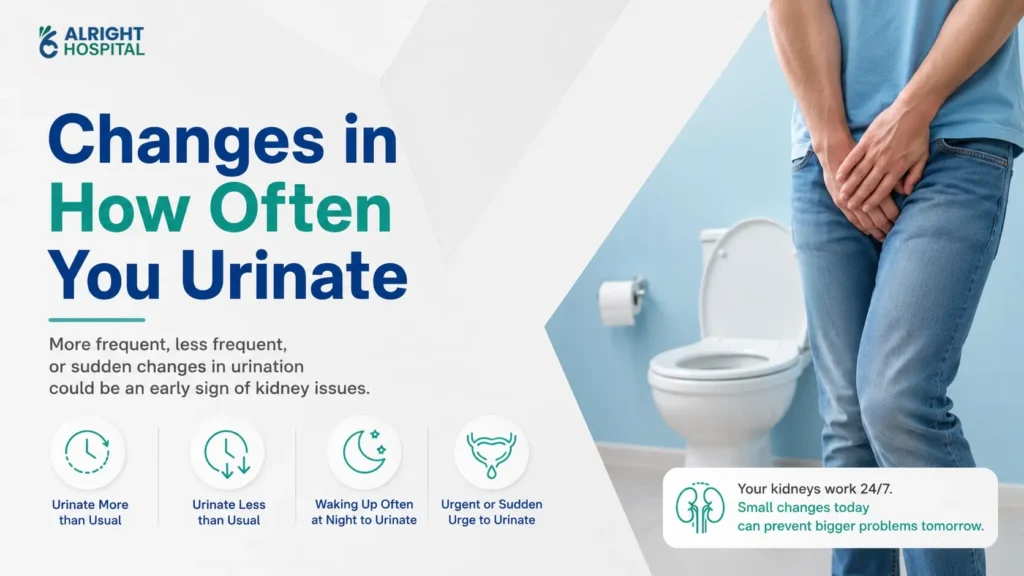
This one takes two opposite forms, and both matter. Some people with kidney disease urinate more frequently, especially at night, a symptom called nocturia. If you are suddenly waking up two or three times at night to use the bathroom when this was not your pattern before, that change in itself is worth mentioning to a doctor.
Others notice they are producing less urine than usual, and what comes out may be darker in colour or foamy in appearance. Foam in the urine is particularly significant because it indicates protein is being spilled into the urine, a condition called proteinuria.
Normally, the kidneys retain protein in the blood. When the filtering mechanism is damaged, protein leaks through. As the KDIGO 2024 guidelines noted, consistent foamy urine that takes several flushes to clear is a red flag for proteinuria and warrants a urine albumin test as a priority. [4]
This is a simple test, inexpensive and widely available, but patients rarely ask for it because they do not know foamy urine is telling them something important.

The kidneys produce a hormone called erythropoietin that signals the bone marrow to manufacture red blood cells. When kidney function declines, this hormone output drops, red blood cell production falls, and anaemia develops.
Anaemia means the blood is carrying less oxygen to the body’s tissues, and the result is a fatigue that feels deeper and more persistent than ordinary tiredness.
Patients describe it as feeling like they are carrying extra weight, finding even small tasks exhausting, getting breathless during activities that should not wind them at all, and not feeling refreshed after a full night’s sleep. I want to be honest: fatigue is one of the least specific symptoms in medicine and has dozens of possible causes. But when fatigue is new, progressive, and combined with any other symptom on this list, it should not be dismissed as simply getting older or working too hard.

The kidneys sit on either side of the spine, just below the ribcage. When they are affected by certain conditions, including kidney cysts, stones, or inflammation of the kidney tissue, a dull aching or pressure-like pain can develop in that area. This is different from the sharp, severe pain of a kidney stone passing through the ureter. That kind of pain is hard to miss.
What I am describing is a persistent, background discomfort in the flank region, the sides of the lower back, that has been there for weeks and does not improve with rest or change position. Many patients attribute this to muscle strain, sitting posture, or a general backache.
In people with risk factors for kidney disease, it deserves a proper evaluation including urine and blood tests to rule out a kidney cause.

When the kidneys cannot filter waste effectively, toxins and waste products accumulate in the bloodstream. This is called uraemia, and it produces a distinctive set of symptoms that people rarely connect to their kidneys.
The most common are persistent nausea, sometimes accompanied by vomiting, a significant reduction in appetite, and a metallic or ammonia-like taste in the mouth. Some patients notice a change in how food smells to them or find that foods they previously enjoyed now seem unappealing. Unintended weight loss can follow as a result of reduced food intake over time. [5]
In clinical practice, a published review confirmed that a buildup of toxins due to declining kidney function consistently causes nausea, vomiting, and food aversion in CKD patients. These symptoms typically appear in the later stages of CKD but can be present earlier in some patients, especially if the kidney function has declined quickly. [5]
If you or a family member has been experiencing persistent nausea without a clear gastrointestinal explanation, and especially if any other symptoms on this list are also present, a kidney function test should be part of the workup.

This is one of the symptoms patients are most surprised to hear has a kidney connection. Severely itchy skin, medically called pruritus, that is not related to any visible rash, allergy, or skin disease, is a recognised manifestation of advancing kidney disease.
When waste products accumulate in the blood due to impaired kidney filtration, they can deposit in the skin and trigger nerve-related itching. A comprehensive systematic review published in the Journal of Clinical Medicine in 2025 confirmed that dermatological manifestations including itching, skin dryness, and changes in pigmentation are recognised clinical indicators of CKD and correlate with declining glomerular filtration rate. [6]
Patients often consult a dermatologist for this, which is entirely reasonable, but when no skin cause is found and the itching persists, kidney function should be checked. It is a symptom that sits quietly in plain sight and rarely gets correctly attributed until much later in the disease course.

The relationship between hypertension and kidney disease runs in both directions. Longstanding uncontrolled blood pressure damages the small blood vessels in the kidneys, causing progressive loss of kidney function. And damaged kidneys, in turn, lose their ability to regulate blood pressure normally, making hypertension worse and harder to control with standard medications.
If your blood pressure has been well managed for years and has suddenly become harder to control despite medications, or if you have recently been found to have high blood pressure for the first time along with any of the symptoms above, a kidney evaluation is part of what your doctor should do. The SEEK-India study found that 27 percent of adults with hypertension in India had CKD, compared to 14 percent in the general population. [2]
The coexistence of the two conditions is common, and it is clinically important because each condition accelerates the other.
This is the question I most want people with risk factors to read and internalise. If you have diabetes, you should have your urine albumin and kidney function tested at least once a year, regardless of whether you feel anything. If you have longstanding high blood pressure, same rule applies.
If a parent or sibling has been on dialysis or had kidney failure, your own kidney function should be evaluated proactively. If you have had repeated kidney infections, kidney stones, or been on long-term NSAID painkillers such as ibuprofen or diclofenac, your kidneys need monitoring. The tests required are not complicated.
An eGFR blood test and a urine albumin-to-creatinine ratio together provide a clear picture of where your kidney function stands. The 2024 KDIGO guidelines, the most authoritative international guidance for kidney disease management, recommend running both tests together for the most accurate early detection. [4]
A nephrologist is a physician who specialises in kidney disease. The first appointment typically involves a detailed history and examination, followed by blood and urine tests to assess kidney function, identify the cause of any abnormality, and stage the disease if CKD is confirmed.
Depending on findings, the specialist may recommend a kidney ultrasound, a kidney biopsy in some cases, or referral for blood pressure management, diabetes optimisation, and medications specifically shown to slow CKD progression.
The good news, and I want to make sure this is heard clearly, is that stages 1 through 3 of CKD can often be meaningfully slowed or stabilised with the right treatment. SGLT-2 inhibitors, several of which received expanded approvals in 2025, have demonstrated significant kidney-protective effects in clinical trials, reducing the progression of CKD in patients with and without diabetes. [4]
Full reversal of established CKD is rare, but preserving remaining kidney function for years, sometimes decades, is very achievable when the condition is caught and managed early.
In my experience, two things stop people in Nagpur from seeing a specialist in time.
One is the assumption that because they feel okay, nothing serious can be wrong. The other is the belief that a kidney problem will make itself known loudly enough that they will have no choice but to act. Both assumptions are wrong when it comes to CKD.
The kidneys are remarkably resilient. They compensate for damage for a long time before letting you know something is wrong. By the time the symptoms I have described above are impossible to ignore, the disease is often well advanced. If you have diabetes, high blood pressure, or a family history of kidney disease, please do not wait for a symptom to push you toward evaluation.
A simple blood and urine test done today can tell you where you stand and give you the time to act before your options narrow. At Alright Hospital, our internal medicine and nephrology consultation services are available at both the Jafar Nagar and Lashkaribagh branches.
If any of the warning signs in this article apply to you, please come in. Early diagnosis is not just better medicine. It changes lives.
The monsoon brings relief from Nagpur's summer heat, but it also brings waterlogging, humidity, and the perfect breeding ground for...
Heart attacks in men under 45 are rising across Nagpur and Vidarbha. Learn why young cardiac events are increasing, how...
Same symptom, very different condition. A Nagpur nephrologist explains how to tell kidney stones apart from chronic kidney disease.