

Breast Cancer Awareness Month: Early Signs, Self-Examination and Screening Guide
October is Breast Cancer Awareness Month. Learn the early signs of breast cancer, how to do a breast self-examination, which...
Team Alright
April 24, 2026
If your doctor has recently mentioned the word TAVI or told you that your heart valve needs attention, you are probably carrying a lot of questions and a fair amount of anxiety. What exactly is this TAVI procedure? Is it surgery? Will it require opening the chest? Who is it for? Is it available in Nagpur?
This guide is written to answer those questions in plain language, without medical jargon, so that you and your family can understand what TAVI Procedure is, when it is recommended, and what to expect if your cardiologist suggests it.
To understand TAVI, you first need a quick picture of what it is designed to treat. The heart has four valves that act like one-way doors, ensuring blood flows in the right direction as the heart beats. The aortic valve is one of the most important of these. It sits between the left ventricle, the heart’s main pumping chamber, and the aorta, the large artery that carries oxygen-rich blood to the rest of the body.
In a condition called aortic stenosis, this valve becomes narrowed over time. The most common cause is a gradual buildup of calcium deposits on the valve leaflets, the flap-like structures that open and close with each heartbeat. As the narrowing worsens, the valve cannot open fully, the heart has to work harder and harder to push blood through the smaller opening, and eventually the heart begins to strain under that extra workload.
Aortic stenosis is most common in older adults, typically those above the age of 65, and it progresses slowly over years before causing noticeable symptoms. When symptoms do appear, the condition has usually reached a serious stage. The three main symptoms to watch for are chest pain or tightness, especially during activity, unexplained fainting or near-fainting episodes, and breathlessness that has been gradually worsening. At this stage, treatment is not optional. Without intervention, severe symptomatic aortic stenosis carries a very poor outlook.
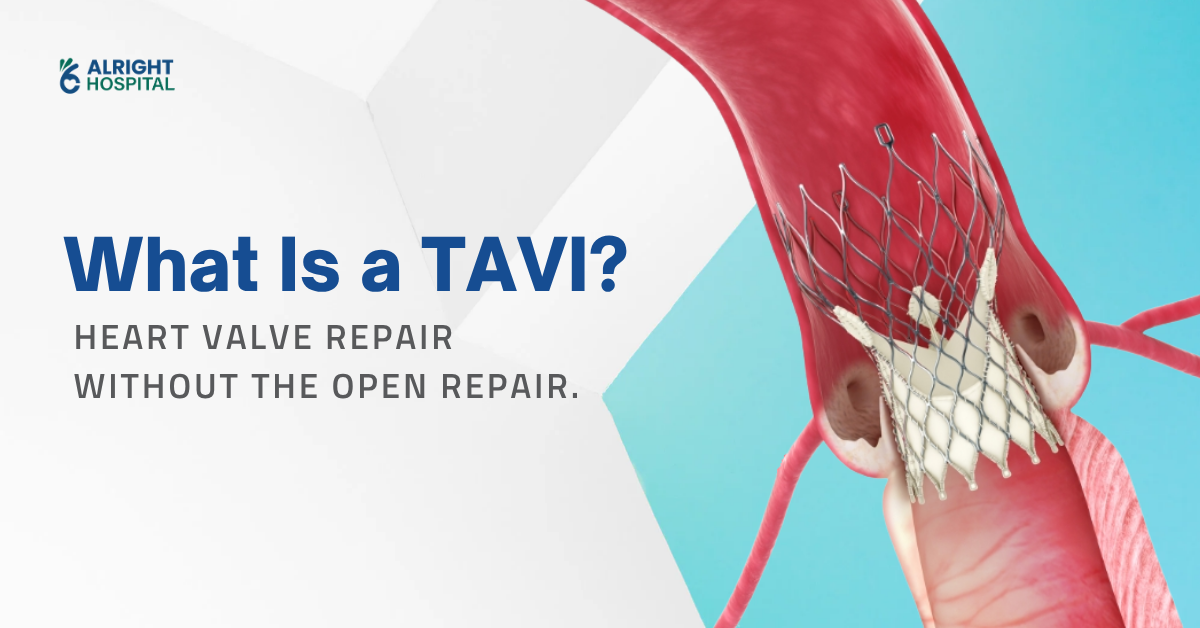
TAVI stands for Transcatheter Aortic Valve Implantation. In some countries and publications you may also see it called TAVR, which stands for Transcatheter Aortic Valve Replacement. Both terms refer to the same procedure.
In simple terms, TAVI is a way of replacing a damaged aortic valve without open-heart surgery. Instead of cutting open the chest and stopping the heart, the procedure is done through a thin, flexible tube called a catheter that is guided through a blood vessel, most commonly the femoral artery in the groin, directly to the heart. A new valve, compressed tightly around a small balloon or within a collapsible metal frame called a stent, is delivered through this catheter to the exact site of the diseased valve. Once in position, the new valve is expanded, it pushes the old calcified valve aside, and begins working immediately.
The patient’s heart continues beating throughout the procedure. There is no need for the heart-lung bypass machine that is required in traditional open-heart surgery. Most patients are given sedation or light general anaesthesia, and the procedure typically takes between one and three hours depending on the complexity.
TAVI was originally developed for patients who were considered too high risk for traditional open-heart surgery. This includes elderly patients, typically those above 75, patients with other serious medical conditions such as advanced lung disease, kidney disease, or frailty, and those who have had previous cardiac surgeries that make reoperation especially dangerous.
For these patients, the traditional surgical approach carries risks that are too high to justify, but leaving the valve untreated is also life-threatening. TAVI was the answer to this dilemma, offering an effective valve replacement through a far less invasive route.
Over the past decade, as the technology has refined and long-term outcomes data has matured, TAVI has gradually been extended to intermediate-risk and in many centres now even lower-risk patients who prefer a less invasive option. The decision about whether TAVI or surgical valve replacement is the right choice for any individual patient is made by a cardiac team that typically includes an interventional cardiologist and a cardiac surgeon reviewing the full picture together.
Before a TAVI procedure, the cardiac team will conduct a thorough evaluation. This typically includes a detailed echocardiogram, which is an ultrasound of the heart that measures the severity of the valve disease, a CT scan of the chest, aorta, and peripheral arteries to map the exact anatomy and plan the best access route, blood tests, an ECG, and an assessment of overall health and functional status.
This pre-procedure workup is important because TAVI valves come in different sizes and the valve must be precisely matched to the patient’s anatomy. Getting this step right is what determines how well the new valve seats and functions after deployment.
Patients are usually advised to inform the team about all medications they are taking, as some blood thinners or other drugs need to be adjusted before the procedure.
On the day of the procedure, patients are taken to a catheterization lab or a hybrid operating theatre. The access site, usually the groin, is cleaned and numbed. A small incision is made and the catheter system is introduced into the artery and guided under X-ray imaging up through the aorta to the heart.
Most patients are awake but sedated and feel no pain during the procedure. Once the new valve is deployed and the team confirms through imaging that it is functioning correctly, the catheter is withdrawn and the access site is closed. The entire procedure often takes around ninety minutes to two hours for a straightforward case.
Recovery after TAVI is one of its most significant advantages over traditional surgery. Most patients are able to sit up the same day, are walking within one to two days, and are discharged from the hospital within three to five days. Compare this to the six to eight week recovery typically associated with open-heart surgery, and the difference in quality of life, particularly for older patients, is substantial.
After discharge, patients are usually prescribed blood-thinning medications for a period determined by their cardiologist, and regular follow-up appointments are scheduled to monitor how the new valve is performing.
This is one of the most common questions I hear from patients and their families. Based on current evidence, TAVI valves are durable and function well for at least ten to fifteen years in the majority of patients. Longer-term data is still accumulating as the procedure is relatively newer than surgical valves, but the results so far are reassuring.
For patients in their seventies and eighties, this duration is typically sufficient for the remainder of their natural lifespan. For younger patients, the durability question requires a more detailed conversation about the relative merits of TAVI versus surgical replacement, which your cardiologist can guide you through based on your specific situation.
Yes. TAVI is available in Nagpur at centres with advanced interventional cardiology facilities and catheterization labs equipped for structural heart procedures. At Alright Hospital, our cardiac team evaluates patients with aortic valve disease and discusses all treatment options including TAVI for those who meet the clinical criteria.
If you or a family member has been diagnosed with aortic stenosis, or if symptoms like breathlessness, chest tightness, or unexplained fainting have appeared, the right first step is a formal cardiac evaluation. An echocardiogram and a consultation with a cardiologist will clarify how severe the valve disease is and what treatment approach is appropriate.
Please do not delay this evaluation because symptoms have appeared. Symptomatic aortic stenosis is one of the conditions in cardiology where time genuinely matters.
Patients often ask whether TAVI is painful. Most describe the procedure as surprisingly comfortable given that they expected something much more difficult. The sedation ensures there is no pain during the procedure, and post-procedural discomfort is generally mild.
Patients also ask whether they can return to normal activities after TAVI. The majority of patients who undergo TAVI report a significant improvement in their breathlessness and energy levels within weeks of the procedure, often returning to daily activities and light exercise they had given up due to their valve disease. The improved blood flow through the new valve allows the heart to work more efficiently, and many patients feel meaningfully better than they have in years.
Finally, patients ask about the risks. Like all medical procedures, TAVI carries risks including stroke, bleeding, the need for a pacemaker in some patients, and very rarely procedural complications. Your cardiologist will discuss these in detail and weigh them against the risks of not treating the valve disease, which in severe symptomatic cases are considerably higher.
If you are reading this as a family member of an elderly parent or relative who has been told they have a heart valve problem, please know that age alone is not a barrier to treatment. TAVI was in many ways designed precisely for older patients who deserve effective treatment without the burden of major surgery. A frail seventy-eight year old who cannot tolerate open-heart surgery may be an excellent candidate for TAVI and may go on to live a significantly better quality of life after the procedure.
Bring your questions to the consultation. Ask about the risks, the recovery, the alternatives, and what the likely outcome is without treatment. A good cardiac team will take the time to explain everything clearly and help your family make an informed decision.
At Alright Hospital, Nagpur, our cardiology team is available at the Jafar Nagar and Lashkaribagh branches for evaluations, second opinions, and TAVI consultations.
October is Breast Cancer Awareness Month. Learn the early signs of breast cancer, how to do a breast self-examination, which...
Nagpur spine specialists explain the key differences between a slip disc, sciatica, and spondylitis, how each is diagnosed, and which...
Nagpur nephrologist explains why monsoon dehydration silently harms your kidneys, raises stone and infection risk, and how to stay protected...